
We create high-quality reproductions of artwork with careful attention to color, detail, and character—so your piece can be preserved, shared, or sold with confidence.
Whether you’re an artist selling prints or just wanting to preserve something meaningful, our goal is simple: a print that feels true to the original work.
You’ve put time and care into your work. The reproduction should reflect that.
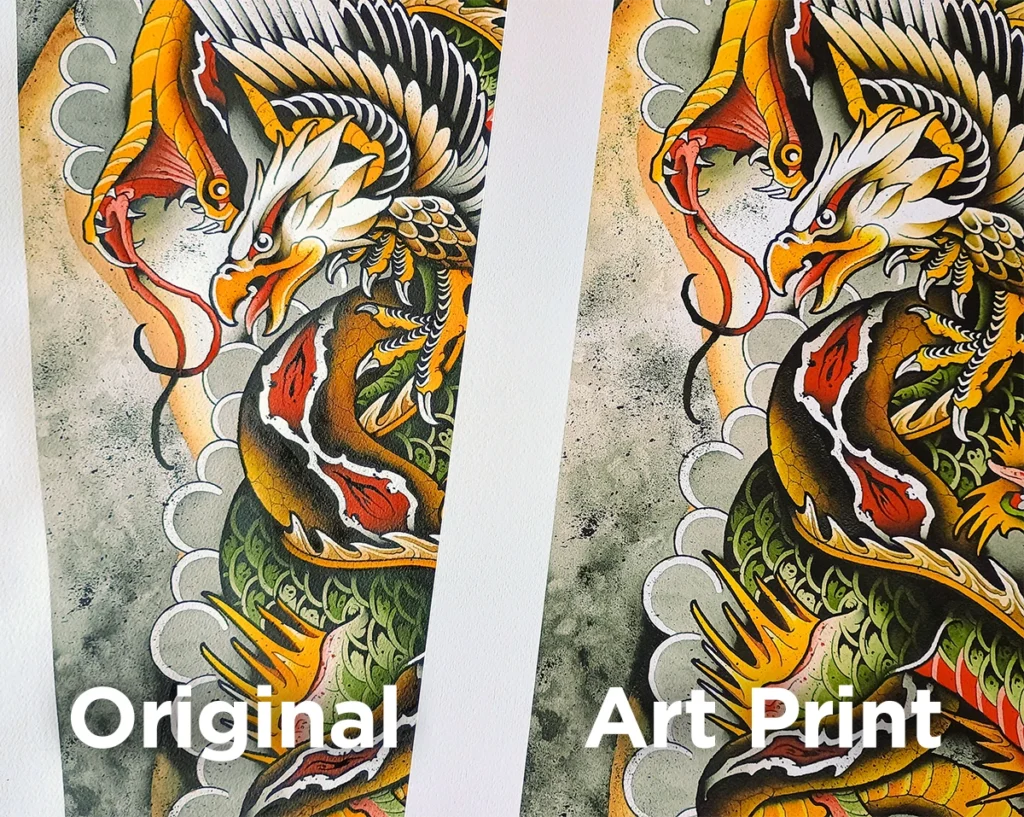
Artwork reproduction is more than printing—it’s translation.
Original pieces are created in a wide range of materials, lighting conditions, and color environments. Our job is to interpret that work for print in a way that preserves its overall look and feel.
The result is a reproduction that reflects the character of the original, with balanced color and thoughtful attention to detail.
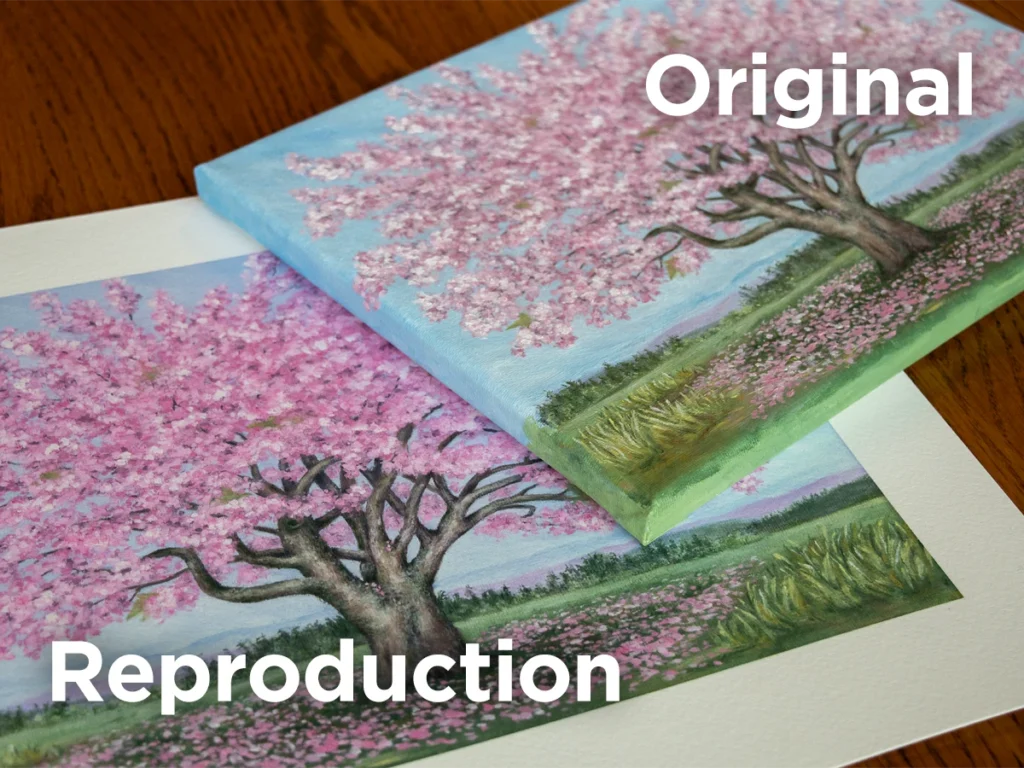
You’re creating work meant to be shared, sold, or exhibited. Your reproductions need to be consistent, reliable, and true to your vision.
We help produce prints that are suitable for editioning, resale, and gallery presentation—without overcomplicating the process.
Sometimes the goal isn’t selling—it’s preserving.
Family artwork, heirlooms, or one-of-a-kind pieces deserve careful handling and thoughtful reproduction so they can be enjoyed for years to come.
You don’t need to ship your artwork across the country or rely on an unknown production facility.
Working with a local reproduction studio in the Tri-Cities means:
This keeps the process transparent, personal, and accountable from start to finish.
We regularly work with artists and clients throughout Kennewick, Pasco, Richland, and the surrounding Eastern Washington and Northeast Oregon regions.
No matter the project, our approach stays the same: careful, experienced, and focused on a result that feels right.
To respect artists and maintain the standards of our work, we observe a few basic guidelines:
If you’re unsure about your piece, feel free to send us a photo—we’re happy to take a look and let you know what’s possible.
We regularly reproduce a wide range of artwork, including paintings (oil, acrylic, and watercolor), drawings, illustrations, photography, and mixed media pieces.
Most flat artwork reproduces very well, including paintings, drawings, and photography.
Highly textured, reflective, or three-dimensional works may not translate perfectly into a flat print.
We are also unable to reproduce copyrighted artwork without permission.
We may decline projects that include explicit or inappropriate content.
Most scan-and-print projects are completed within 2–5 business days.
Timing can vary depending on artwork size, quantity, and any additional adjustments or proofs. If you have a specific deadline, let us know—we’ll do our best to accommodate it.
Artwork should be dropped off in person during regular business hours.
An appointment is recommended if you’d like to review samples or discuss your project, but is not required for simple drop-off.
If dropping off without an appointment, please include your name, contact information, and any relevant project details such as size, quantity, or special instructions. We’ll follow up once your artwork has been reviewed.
Scanning starts at $40 per piece for artwork up to 12” × 17”.
Each scan is captured at 360 pixels per inch and includes basic color adjustment to achieve a visually accurate reproduction. Larger pieces are scanned in sections and seamlessly stitched together.
Final scan files are provided to you for future use.
Higher-resolution scanning (up to 2400 ppi) is available for an additional fee.
Yes—we can print directly from your file.
For best results, send the highest-resolution version available (TIFF, PSD, or high-quality JPEG preferred). Avoid screenshots, social media downloads, or heavily compressed files, as they often lack the detail needed for high-quality printing.
A Note on Color:
When we work from your file instead of scanning the original artwork, we don’t have the same ability to compare directly against the physical piece. Because of that, color accuracy may require more interpretation.
If adjustments are needed after reviewing a print or proof, we can work with you to fine-tune the file. Additional image editing is available as an hourly service.
You retain full ownership of your original artwork and all associated rights.
Once scanning and file preparation are complete, the resulting digital files are provided to you for your personal or professional use, including future printing or reproduction of your own work.
We do not claim ownership of your artwork or its reproductions.
If we create any adjusted scan files or print-ready versions as part of your project, those files are also considered yours. We retain copies only for the purpose of facilitating reprints and maintaining consistency within our stated file retention period.
We capture your artwork as accurately as possible, including existing surface details.
Basic cleanup (such as dust removal or minor artifacts) may be included when needed. More extensive restoration—such as repairing damage or reconstructing missing areas—is available as additional paid image editing.
Photography can be used, but it introduces variables that can affect accuracy and consistency.
Factors such as lighting, camera quality, lens distortion, and reflections all influence the final image. Even small differences in setup can lead to noticeable shifts in color, contrast, and detail.
Scanning removes many of those variables because the artwork is captured under controlled, consistent conditions. This helps ensure detail and color are captured as faithfully as possible.
If an image does not have enough resolution for high-quality printing at your desired size, we’ll let you know before anything goes to print.
Low-resolution files can still sometimes be printed, but increasing the size too far can result in visible softness, pixelation, or loss of detail. In these cases, we’ll typically recommend one of the following options:
We’ll always review your file and help you understand what kind of result you can expect before moving forward, so there are no surprises in the final print.
Yes—we retain your files for up to 2 years to support reorders and consistency.
After that period, files may be archived or removed. If long-term retention is important, let us know.
We always recommend keeping a personal backup of your original files as well.
Reproducing artwork with a high degree of accuracy is always our goal, but a perfect one-to-one match isn’t always possible.
Instead, we focus on preserving the overall relationships between colors, contrast, and the character of the original piece so the final print feels true to the artwork when viewed on its own.
When we scan your artwork, we use calibrated equipment, color targets, and standardized workflows to ensure the digital file translates into “pleasing color” when printed. If more precise or hands-on color adjustments are needed, we offer that as an additional service billed hourly.
On the printing side, each printer has a limited color gamut—the range of colors it can reproduce. Highly saturated colors in traditional media (like oils or pastels) may fall outside that range, so they are instead mapped to the closest printable equivalent, which can appear slightly less intense in print.
When viewed independently, a well-made reproduction should feel accurate and balanced. When compared directly side-by-side with the original, subtle differences may be visible.
“Pleasing color” refers to color reproduction that looks right to the eye.
Because of the inherent limitations of printing, a perfect one-to-one color match isn’t always possible. But what matters is that the print feels true to the original—capturing its color relationships, contrast, and overall character in a way that’s visually satisfying.
If placed side-by-side with the original, you may notice subtle differences in the print. But viewed on its own, a well-made reproduction stands confidently as a faithful representation of the piece.
Remember, an original is always one of a kind—that’s part its value. A reproduction serves a different purpose: to share that work in a form that remains true to the artist’s intent.
Yes—colors will almost always look slightly different on screen than they do in print.
Screens emit light, while prints reflect it, which naturally changes how color, brightness, and contrast are perceived. In addition, every screen is calibrated differently, meaning the same file can appear noticeably different from one device to another.
Because of this, on-screen previews are best used as a general guide rather than an exact representation of the final print.
We aim for strong consistency between print runs using the same file and materials.
However, minor variations can occur due to normal differences in calibration, inks, and materials. For the most consistent results, we recommend producing multiple copies in a single print run whenever possible.
Print width is limited to 44 inches, based on our roll media.
One dimension can be up to 44 inches wide, with length varying based on the artwork proportions.
Print pricing is based on the media being printed on and the total area of the print:
A file setup fee also applies:
Quantity discounts are available at 5, 10, 15, and 20+ identical prints.
Paper Options
Double-Weight Matte — $10/sq ft
A smooth, non-coated paper. While not archival, it holds color well for years under normal display conditions. 230 GSM / 12 mil
Luster Photo — $12/sq ft
A lightly textured coated photo paper that reduces glare with excellent color depth. 255 GSM / 10 mil
Velvet Art Paper — $15/sq ft
Our most popular choice for fine art reproductions. A 100% cotton rag paper with a soft, watercolor-like texture. Archival-rated for 100+ years. 300 GSM / 18.5 mil
Canvas Options
Gloss Canvas — $18/sq ft
A ready-to-go gloss canvas ready for stretching or mounting —no varnishing required. Rated for 55+ years display life | 440 GSM / 21 mil
Archival Canvas with Varnish — $27/sq ft
Our premium canvas option with a post-print protective varnish for enhanced durability and longevity. Can be safely dusted or wiped clean and is ideal for long-term display. Rated for 100+ years display life | 390 GSM / 20 mil
Other Materials
We also print on a range of specialty substrates for non-art applications, including metallic photo paper, scrim vinyl, Tyvek, plastic films, and lightweight papers.
Yes—we can resize your artwork to fit different print dimensions, and we always do this with care to preserve the integrity of the original composition.
In some cases, resizing may require slight cropping or adjustment depending on the aspect ratio of the final print. When that happens, we make sure to keep the most important parts of the image centered and visually balanced.
If a specific crop or layout is important to you, we recommend letting us know ahead of time or requesting a proof so you can review the composition before final printing.
More extensive layout changes or compositional redesigns are available as additional image editing services and are billed at an hourly rate.
Yes—proofs are available upon request.
We typically provide either a small test strip or a reduced full-image print so you can review color and detail before final production. This is especially helpful for color-critical work or when printing from a supplied digital file.
We want you to be happy with your final prints, and we’ll always work with you to get there.
If there’s an issue related to print quality—such as a defect or something that clearly falls outside our normal standards—we’ll make it right.
Color, however, can be more subjective. While our process is designed to produce accurate, visually pleasing results, individual preferences can vary—especially when comparing a print to the original artwork or viewing it under different lighting conditions.
If you’d like to fine-tune color or make adjustments after seeing a print, we’re happy to do that as part of an additional round of editing and reprinting. Many clients choose to request a proof in advance for this reason, especially for color-critical work.
Our goal is to deliver a result you feel confident putting your name on—and we’ll work with you to achieve that.
We offer mounting on foam core and Gator board.
We also offer limited canvas stretching, though this is not our primary finishing service. Framing is not offered.
We print using an Epson SureColor P8000 large-format pigment ink printer.
This professional system is designed for fine art reproduction, producing a wide color range, smooth gradients, and archival-quality output on both paper and canvas.
We also offer alternative printing options for smaller or non-fine-art applications such as postcards, note cards, and similar items.
Yes—our prints fall under what is commonly referred to as giclée printing.
This refers to high-quality inkjet printing using archival pigment inks and fine art materials, rather than a specific machine or certification.
Still have questions?
Give us a call or contact us below. We’re happy to help.